

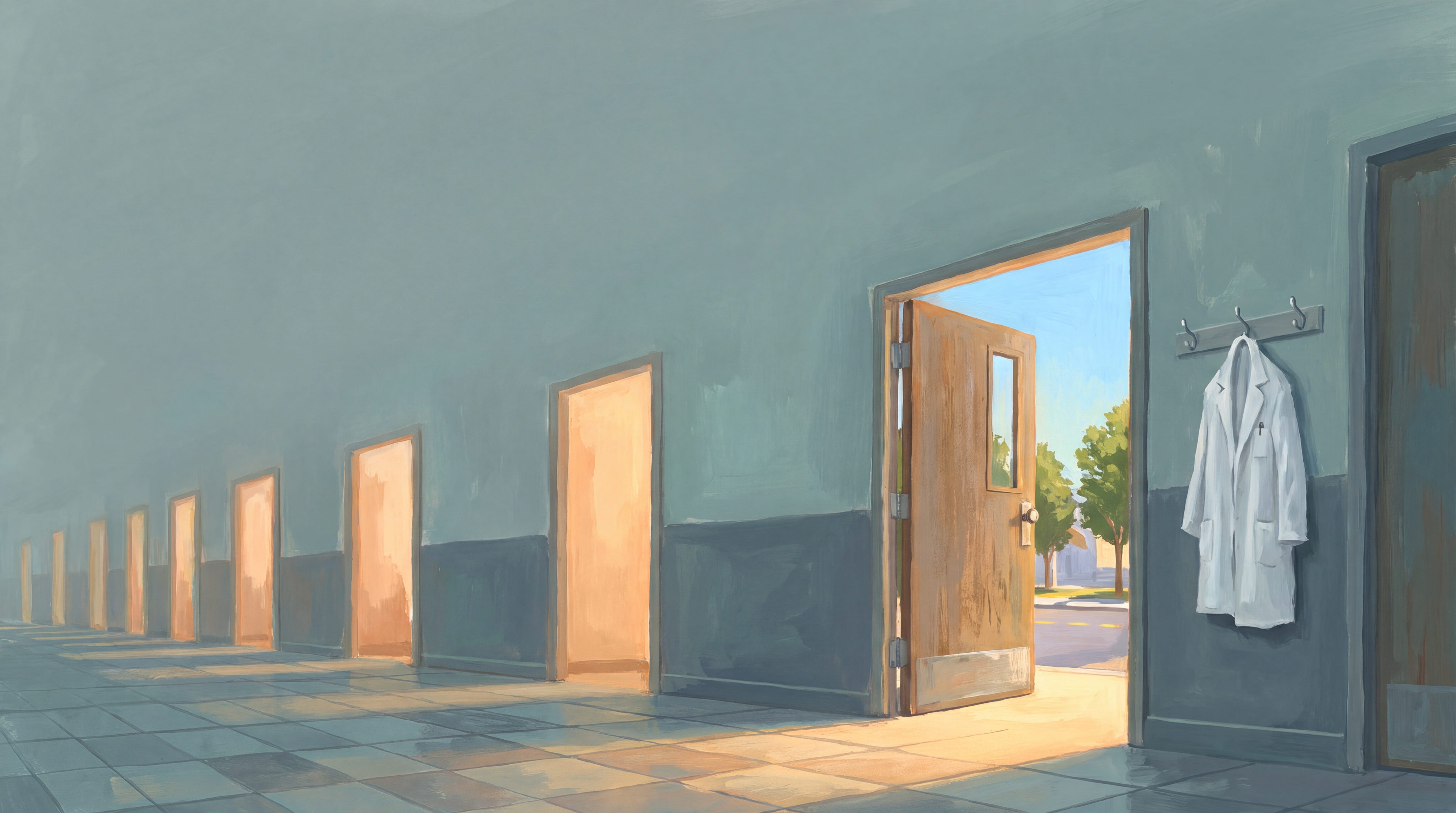
When Adil told his chairman he was resigning from Baylor to open his own orthopedic practice, the department sent out the usual announcement. Then the questions started. He told me about them on our podcast, and it was the same question over and over.
“Are you really going, like, solo?”
His colleagues assumed he meant joining an existing group. That’s the normal way out of academics: you go to a practice that already has a workflow, an overhead structure and a billing company, and you plug in. Adil meant from scratch. A lease, an entity, a fax line, a first hire. “As brick and mortar startup as you can get,” he said. “Most of my colleagues think I’m crazy. They’re like, there’s no way. Can you even do that?”
I laughed, because I got the same look four or five years ago. I told people in fellowship that I was going to start my own cardiology practice right out of training, and I’m sure plenty of them thought, this idiot thinks he can do this. Some of the time I thought it too. I had never been taught how to run a business. Imposter syndrome hits hard in the beginning, and the question underneath it is a simple one: if this is possible, how come nobody is doing it?
The knowledge lives outside the building
Here’s what I said to Adil, and I keep thinking about it. You don’t get that kind of encouragement inside an academic center, because almost none of the people in that setting have done it. Very rarely do you find someone there who truly started from scratch.
That isn’t a criticism of academic medicine. It’s just what the building selects for. The attendings who trained you are the people who stayed. They can teach you how to place a screw, read an echo, write a paper and survive a tough case conference, and they teach those things well. Ask them how long Medicare credentialing takes for a new practice location, or what a registered agent is for, and they’ll shrug, because they never had to find out.
So the knowledge of how to leave sits with people who already left, and you have to go find them.
I found mine through family connections and family friends. I knew a couple of people who had done it, and they told me it was possible. That was the only reason I moved forward. Otherwise I wouldn’t have believed it could be done.
Adil found his at academic conferences, which is a little ironic. One is an orthopedic surgeon in Detroit, seventeen or eighteen years in practice, who left a larger group and built a solo practice that is doing very well. Adil had never trained with him or worked with him. He knew him from meetings and research. Another left a big group in Phoenix and did the same thing. The part Adil kept coming back to wasn’t the encouragement. It was the mistakes they were willing to share. “Man, I did this and I would not do that again.” That was the part no textbook was going to give him, because, in his words, there is no playbook. There’s no set path to succeeding in business. You figure it out, and it helps a lot to hear from someone who already did.
Why this gets worse every year
This is the part that bothers me.
In the AMA’s 2024 Physician Practice Benchmark Survey, 35.4 percent of physicians had an ownership stake in their practice. In 2012 it was 53.2 percent. In the early 1980s it was around 76 percent. Only 42.2 percent of physicians now work in a practice wholly owned by physicians.
The AMA’s explanation is payment rates, costs and administrative burden, and I agree that those are the drivers. But there is a second effect that nobody puts in a chart. Every physician who sells or never starts is one fewer person a resident can call and ask, how did you do this? The pool of mentors shrinks along with the pool of owners. Fewer owners means fewer people to show the next generation the way, which means even fewer owners after that. Nobody has measured that loop, as far as I know, but I’d bet on it.
A trainee today is far less likely than one a generation ago to have an attending, an uncle or a neighbor who owns a practice. If that trainee’s whole world is a hospital system, then going independent looks like the crazy option, and that impression has nothing to do with whether it is actually a good idea. It just reflects who they happened to be around.
What the people who left owe
If the knowledge is held by the people who left, then the people who left have to give it away.
When I started my practice I was pretty vocal about it, and a lot of physicians reached out. Some of them went on to start their own practices, and I walked them through it. Nothing in this job makes me happier than watching a physician break off from a big group or an academic setting and go on their own. Even if a new cardiologist opens near me, I’m happy to show them around and figure out how we can work together.
The older mindset was that the new guy is competition and he’s going to take your patients. I don’t see that much in my generation. There are a few of us who started our own cardiology practices, and we have WhatsApp groups and talk on the phone and trade ideas. Sometimes something clicks in one of those conversations and I realize I should be doing it a different way. Plenty of the senior cardiologists here have been very encouraging too. I think that culture is a big part of why solo and small practices are still doing well in Houston.
Adil saw something in this that I hadn’t put into words. These outside colleagues end up replacing what he’s about to lose.
The loneliness nobody mentions
Because private practice is a lonelier place, and I told him so.
In fellowship we would walk into the lunchroom, sit with our attendings, joke around and argue about cases. Adil has a whole group with him right now: a resident, a medical student, sometimes a fellow, sometimes more people than can scrub in. He told me the thing he loves most about Baylor is teaching. He explains why he’s putting a screw here or using this size implant for a shoulder, and he watches it click for a resident. “All that is not gonna be there,” he said. “And I think I’m gonna miss it.”
I warned him that he’ll be in the OR trying to tell the tech about an interesting anatomic variant, and the tech will want him to hurry up and finish the case. He knew exactly what I meant.
The harder part is that most of the people you see every day now work for you. You’re their boss. They tense up a little when you walk in. They don’t joke with you the same way, and they hesitate to tell you that you’re wrong. You can work against that. I still host medical students, nurse practitioner students and foreign students, with a curriculum and journal club, and I don’t charge them, because they’re already struggling. I still enroll patients in clinical trials. But you have to build the room you used to just walk into.
So my advice for anyone thinking about this is less about leases and credentialing than about people. Find the few who have done it before you need them, because nobody inside your building is going to introduce you. After you’ve done it, take the call from the next person who asks.
Adil is opening the Houston Upper Extremity Center two floors below my office. I’ll be taking his calls.
This essay grew out of Episode 31 of 2Docs1Mic, “How to Start a Private Medical Practice From Scratch,” with Dr. Adil Ahmed:
Sources
Carol K. Kane, PhD. Physician Practice Characteristics in 2024: Private Practices Account for Less Than Half of Physicians in Most Specialties. AMA Policy Research Perspectives, 2025: https://www.ama-assn.org/system/files/2024-prp-pp-characteristics.pdf
This resonated. Your line that "the knowledge of how to leave sits with people who already left" describes how a lot of practical know-how moves in medicine: through people who have done it and are willing to share the mistakes, not just the encouragement. I also appreciated that you framed it as what the building selects for rather than a criticism of academic medicine. The AMA ownership numbers you cite make a clear case for why those conversations matter more every year.